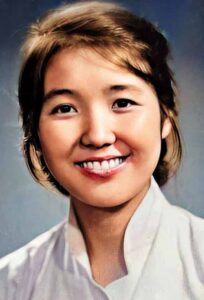
Baohua Zhou (1936-2022) was a gouache artist, craftswoman, and cross-stitch designer from the southwestern China province of Yunnan. Of the hundereds of paintings in her estate, remarkably, half were made with her left hand due to physical challengesBorn and raised in Kunming, China, this artist dedicated her entire life to gouache watercolor painting, decorative pattern and a cross-stitch pattern designing.
Her paintings are visually characterized by vibrant colors and powerful images that combine
eastern and western elements in her paintings. Throughout her artistic career, Zhou remained detached from fame and fortune, and the majority of her works were never publicly exhibited.
She saw the day in 1936 where she was born into a wealthy family that gave her the opportunity to grow and develop her creative passion for painting. In this privileged milieu, she received an above averaged education and was generously provided for during her childhood and early teenage years.
The Chinese revolution and social upheaval between the poor and the wealthy in 1949 gave way to her family’s wealth and their assets being confiscated, leaving them in poverty. None the less, they eventually managed to survive on faith and hard work.
In 1953, Zhou gained admission to the renown Sichuan Fine Arts Institute through discipline and self-study. She learned painting under the guidance of Mr. Li You Xing who was able to taint his student with his profound artistic knowledge of the fine art of painting.
Zhou left the Sichuan Fine Arts Institute (Southwest Academy of Fine Arts) in 1957 although she had proven to be one of her masters most outstanding students. She was forced to quit school due to associating with classmates accused of being far right supporters and sympathizers. In fact, the school expelled her for her associations with this group of people as this marked her first ordeal as a political victim.
She returned to Kunming in 1958 where she started working at Yunnan Printing and Dyeing Factory.
In 1966, the Chinese cultural revolution began, and due to her background of being born into a wealthy family, Zhou was beaten by the Chinese red guards, resulting in the disability of her right hand. There-after, she had no choice but to use her left hand for painting.
Three years later in 1969, during the revolution, Zhou, who was creating art with her left hand, was deprived of her work privileges and sent to the countryside to be reformed and reeducated. During this time, she ceased her artistic creations as she had to raise a young son and newborn daughter.
At the end of the cultural revolution in 1976, Zhou who was considered rehabilitated was able to regained her job at the factory. For 10 years of lost revenues, she was compensated with a lump sum of $1 000 CNY ($139 USD). Subsequently, she was promoted as the chief designer at the Yunnan Printing and Dyeing Factory until her retirement in 1999.
In the end, Zhou Baohua’s artistic career emanated through the struggles of her family’s persecution, the Chinese liberation movement and her resilience to several political ordeals,
As an artist who eschewed fame and fortune, she was one of the most underrated artists of the 1950s, with the majority of her works having never being exhibited. Zhou’s artwork.
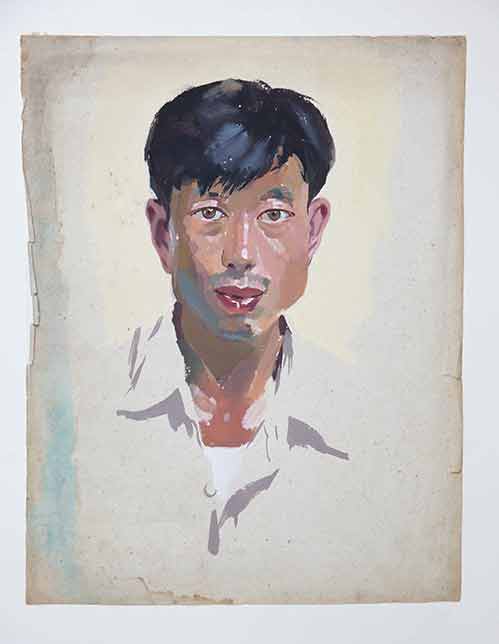
Bangsi Wang (1931-2023) was a celebrated Chinese artist from Kunming, situated in the Yunnan province of China. He was an introverted and modest individual who shied away from the limelight, the majority of his hundereds of works remain undiscovered-He was a well-known artist and craftsman from the south western region of China specializing in watercolor, gouache and oil paintings as well as sketches, and craftwork.
His art consisted of over 450 works made up of watercolor paintings (200 pieces), oil paintings (150 pieces), sketches (100 pieces) and craftworks (pieces lost)
He was born into a middle-class family in Kunming in 1931 as an only child. As his father worked as a geological surveyor and he was not of an artistic bloodline, he was an autodidact painter who learned by observing and working from painting manuals.
In 1948, during the early years of the Chinese liberation period, Wang joined the underground party while still a student, despite strong opposition from his family who even locked him indoors for a period of time.
After the liberation period, he joined the border guerrilla forces where he was enrolled in the armed struggle. Later, he found the opportunity to display his talent and became a solo singer in a military political and cultural group.
A few years later in 1957, Bangsi taught art at the Guangxi Arts Institute.
In 1965, he worked for the Yunnan Provincial Light Industry Department and later made a living by painting movie advertisements for the Kunming Theater.
In the late 1980s, he joined the Yunnan Arts University, where he worked as a professor, specializing in textile and dyeing, until his retirement.
Wang’s artworks can be categorized into three main types. In his early years, he excelled in watercolor paintings, particularly landscapes and natural scenes, with a focus on capturing life-like imagery. His technique was fluid and conveyed the grandeur of mountains and rivers. In his later years, from 2000 onwards, he primarily focused on oil paintings with a more modern style, creating art that was abundant in life and creativity until his later years. Wang’s sketching prowess was astounding, spanning his entire artistic career, from early depictions of people during his travels to later manuscripts, showcasing a wealth of content.
Throughout his life, Wang had a deep passion for freedom and led the establishment of the Yunnan Dai Ethnic Brocade Weaving Factory, promoting natural dyeing and ethnic weaving. He also collected and preserved the traditional weaving arts of Yunnan’s ethnic minority groups. In the 1980s, he was the first to bring Yunnan wax-dyeing art to an exhibition in Chicago, USA.
The artist led a modest and unassuming life, placing little emphasis on fame and fortune. He did not advocate for teaching art, believing that excessive intervention was a major impediment to teaching painting. He is perhaps one of the many artists of the 1950s in China who were underestimated, with the majority of his works remaining unseen. Wang’s artwork.
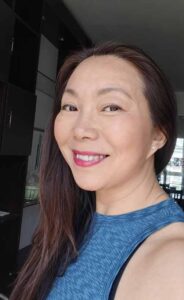
Ni is a third-generation art enthusiast,and the founder of Dada-art, who excels in hand-drawn books. Growing up in an artistic household(Father: Bangsi Wang, Mother:Baohua Zhou), she embraced her parents’ philosophy that painting is just one of the many forms of art. After graduating from university, Ni founded a decorative arts company, engaging in artistic projects such as urban reliefs. In 1997, she decorated a sightseeing cruise ship on Erhai Lake in Yunnan with a capacity for 500 passengers. Despite the success of the art company, Ni, influenced by her childhood dream of exploring the world, sold the business and entered the tourism industry as a professional tour guide for seven years, traveling extensively across China. During this period, she learned French and developed a deep interest in Chinese culture, obtaining qualifications in Tai Chi and intermediate massage therapy.
Demonstrating her capacity for embracing novel pursuits and venturing into uncharted territories, Ni embarked on a diverse array of endeavors. Upon immigrating to Montreal, Canada in 2004, she delved into the fields of sports therapy and kinesiology. Subsequently, in 2008, she dedicated two years to teaching Tai Chi within the local community. Transitioning in 2018, she assumed the role of a school bus driver, a position she held for five years. In 2019, a newfound passion led her to become a local amateur sailor. Finally, in 2023, Ni established Dada Art.
Ni contends that art springs from existence, asserting that each individual possesses innate artistic capabilities. Life, in her perspective, is an art form—an equilibrium, a manifestation of living in the moment. Through the vehicle of Dada Art, she aspires to cultivate increased links, interactions, and dialogues concerning art, painting, aesthetics, and the convergence of Eastern and Western cultures. Ni’s Art

Master of applied arts; Youxing Li (1905 to 1982)
Li Youxing (1905–1982), born in Zitong, Sichuan, studied at the Beijing School of Specialized Art and later at the Lyon Academy of Fine Arts in France. Returning to China, he became professor and later director at the Sichuan Fine Arts Institute, where he pioneered the “Limited Color Painting” technique and trained generations of artists. His works, including the celebrated Mount Emei series, blend Western concepts of color and light with Chinese tradition. As the mentor of Baohua Zhou and Bangsi Wang, Li Youxing nurtured the artistic paths of Baohua Zhou and Bangsi Wang.